
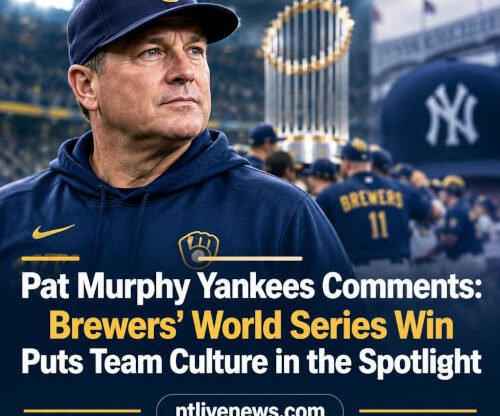

US Sports NEWS l The Milwaukee Brewers have given baseball fans a championship story that goes far beyond home runs, expensive rosters, and individual superstars. After winning the first World Series title in franchise history, Brewers manager Pat Murphy is drawing attention for his blunt comments about the New York Yankees—and for the team culture that helped Milwaukee reach the top of Major League Baseball.
Murphy’s remarks became public after the Brewers defeated the Tampa Bay Rays 4–1 in Game 5 of the 2026 World Series on Wednesday, October 28. In an emotional celebration, Murphy was caught on a hot microphone making a sharp criticism of the Yankees while speaking with Brewers first baseman Jake Bauers, who previously played for New York.
The exchange quickly became a talking point across the baseball world. But the bigger story is what Milwaukee accomplished on the field.
The Brewers finished the regular season with a 103–59 record, swept the defending champion Los Angeles Dodgers in the National League Championship Series, and then defeated the Rays in five World Series games. Their championship run demonstrated how player development, defensive execution, timely hitting, and effective pitching can combine to produce success without the league’s biggest payroll.
As baseball approaches another important labor negotiation, Milwaukee’s achievement has also intensified questions about spending, competitive balance, and whether a salary cap would actually address the sport’s financial disagreements.
What Did Pat Murphy Say About the Yankees?
Murphy’s comments surfaced during the Brewers’ World Series celebration after Bauers handed him the ball associated with the final out. While congratulating the player and discussing his future, Murphy made a critical reference to the Yankees team Bauers played for in 2023.
The remarks characterized that New York club as a team in which players were focused on themselves rather than the collective goal. The language was blunt, and the hot-mic recording quickly attracted attention.
Murphy was speaking in a celebratory moment rather than delivering a prepared statement to reporters. That context matters when interpreting the exchange, although it does not make the comments any less controversial.
The Yankees have long been one of baseball’s most recognizable franchises, with a history of championships, high-profile players, and substantial financial resources. Criticism of the team’s culture can therefore generate a reaction that extends well beyond the original conversation.
Still, Murphy’s remarks should be understood as his opinion, not as proof that every Yankees team or player has the same problem.
The 2023 Yankees finished with an 82–80 record and missed the postseason. Bauers was part of that roster before joining Milwaukee, making him a natural connection between the two organizations.
Murphy’s comments have become part of the championship conversation, but the Brewers’ achievement deserves attention on its own merits.
Milwaukee Brewers Win First World Series Championship
The biggest headline from October 28 is that the Brewers are finally World Series champions.
Milwaukee defeated the Rays 4–1 in Game 5 at Tropicana Field, completing a 4–1 series victory. The franchise had previously reached the World Series in 1982 but had never won the championship.
The victory capped a remarkable postseason. Milwaukee defeated the San Diego Padres in the National League Division Series, swept the Dodgers in the NLCS, and then overcame Tampa Bay in the Fall Classic.
The Brewers won 11 postseason games while losing only twice, according to MLB’s championship coverage. Their performance was built on contributions from across the roster rather than a single offensive star carrying the team.
In Game 5, right-hander Jacob Misiorowski delivered 5⅔ scoreless innings, allowing just two hits. The Brewers built a four-run advantage before Tampa Bay scored once in the ninth inning.
William Contreras was named World Series Most Valuable Player after an outstanding performance behind the plate and at the plate. His work with the pitching staff and timely offensive contributions helped Milwaukee close out the series.
The championship was also a milestone for manager Pat Murphy, whose leadership helped the team navigate a demanding postseason.
For Brewers fans, the title ends a long wait and gives the franchise a place in baseball history that it had pursued for decades.
What Is “Murph Ball”? Inside the Brewers’ Winning Culture
The phrase “Murph Ball” has become shorthand for the Brewers’ approach under Murphy: play together, stay disciplined, execute the fundamentals, and trust teammates to deliver when opportunities arise.
It is not a formal statistical category or a complicated tactical system. Instead, it describes a team identity that combines preparation, resilience, and contributions from players in different roles.
Milwaukee’s postseason offered several examples.
The Brewers swept a Dodgers team that had been pursuing another championship, then regrouped after losing Game 4 of the World Series in extra innings. Rather than allowing that defeat to define the series, they responded with a composed performance in Game 5.
Their success also came from doing more than hitting home runs.
Defensive plays, smart baserunning, situational hitting, and the ability of relief pitchers to protect narrow leads all mattered. The club repeatedly found ways to create pressure without relying exclusively on power hitting.
That approach can be especially valuable in October, when teams face elite pitching and every mistake can change the outcome of a game.
Milwaukee’s roster also reflects the importance of player development. Organizations that identify talent, improve players through their farm systems, and give younger athletes opportunities can build competitive teams without purchasing every major name available in free agency.
That does not mean spending is irrelevant. It means money alone does not guarantee postseason success.
The Brewers’ championship provides a high-profile example of how a well-coordinated organization can turn a collection of individual players into a team capable of winning baseball’s biggest prize.
Why Team Culture Is Back in the Spotlight
The Yankees and Brewers represent different baseball identities, although comparisons between the two organizations should not be reduced to a simple argument about spending versus teamwork.
New York entered 2026 with one of MLB’s largest payrolls and a roster built around established talent. Milwaukee operated with considerably fewer financial resources but produced a 103-win regular season and a championship run.
The Yankees’ season ended in disappointment after the Tampa Bay Rays swept them in three games in the American League Division Series.
That result intensified scrutiny of New York’s postseason approach. The Yankees have historically relied on powerful lineups, and home runs remain an important part of their offensive identity. But postseason baseball often requires teams to succeed in situations where power hitting is not enough.
The Brewers demonstrated that distinction throughout October.
They produced runs through timely hits, pressure on opposing defenses, and effective execution in critical moments. Their pitching staff also limited opponents’ opportunities to turn close games into offensive breakthroughs.
Still, it would be too simplistic to conclude that one team’s culture is universally superior based on a single postseason. Baseball outcomes depend on pitching matchups, injuries, individual performance, roster construction, and the unpredictable nature of a short series.
What Milwaukee has established is a compelling example of a team succeeding through collective execution.
For the Yankees, the challenge is to turn regular-season talent into postseason results. For the Brewers, the challenge will be sustaining their approach after reaching the highest point in franchise history.
MLB Payroll Debate:
The Brewers’ championship arrives at an important moment for baseball’s financial future.
Payroll estimates published during the 2026 postseason placed Milwaukee’s payroll at approximately $146 million and Tampa Bay’s at about $96 million. By comparison, the New York Yankees’ payroll was reported at roughly $308 million, while the Los Angeles Dodgers’ figure was around $339 million.
Exact totals vary depending on whether a source measures guaranteed salaries, active-roster costs, luxury-tax calculations, or other contract obligations. Nevertheless, the broad difference in spending power is clear.
The Brewers and Rays reached the World Series despite operating well below the payroll levels associated with some of baseball’s wealthiest clubs.
Their success has strengthened the argument that scouting, player development, smart roster decisions, and effective coaching can help smaller-market teams compete.
It has also raised a more complicated question: Does the sport need a salary cap to create a more balanced competitive environment?
MLB currently operates without a hard salary cap. Instead, it uses a competitive balance tax, commonly called the luxury tax, that imposes financial penalties on teams exceeding specified spending thresholds.
Some owners argue that a salary cap could reduce spending disparities and make competition fairer. The players’ association opposes a hard cap, arguing that it would restrict players’ earning potential and could allow teams to limit spending.
The Brewers’ championship does not settle that debate. A single successful season cannot establish whether a particular financial system would improve competition across the entire league.
However, Milwaukee’s achievement gives fans a concrete example of what organizations can accomplish through development and roster management, even when they cannot match the largest payrolls.
MLB Lockout 2027
Baseball’s financial debate is especially important because the current collective bargaining agreement is scheduled to expire on December 1, 2026.
According to reporting by Reuters and The Associated Press, a potential work stoppage remains a concern if MLB owners and the players’ association cannot reach a new agreement. A lockout could disrupt preparations for the 2027 season, although a delay or cancellation is not inevitable.
The owners have pushed for a salary cap, while the players’ union has opposed imposing a hard limit on team payrolls. The sides must address that central disagreement alongside other labor issues.
For fans, the timing is frustrating. The Brewers’ championship has provided a memorable finish to the season and a positive story about the sport’s competitive possibilities.
A prolonged labor dispute, however, could shift attention away from the players and toward a financial fight between ownership and the union.
The Brewers and Rays also offer a reminder that competitive balance involves more than setting a payroll limit. Player development, front-office decisions, coaching, and investment in the organization all affect whether a team can build a contender.
Any labor agreement will need to address the financial concerns raised by both sides without undermining the qualities that make baseball compelling to watch.
What Pat Murphy and the Brewers’ Success Mean for Baseball
Pat Murphy’s criticism of the Yankees has generated headlines, but the Brewers’ World Series title is the more important part of the story.
Milwaukee won because its players delivered in high-pressure situations, its pitching staff limited opposing offenses, and its lineup produced runs when opportunities appeared. The club also demonstrated resilience after difficult moments, including its extra-inning loss in Game 4.
Those are qualities that cannot be measured through payroll totals alone.
Murphy’s comments may continue to fuel debate among fans, particularly those who support the Yankees. Yet the championship itself offers a broader lesson: baseball teams can find different routes to success, and no single roster-building strategy guarantees a title.
The Brewers now face the challenge of defending their achievement and keeping their winning culture intact. The Yankees, meanwhile, must evaluate how to translate their resources and regular-season performance into better postseason results.
Beyond both clubs, MLB faces a critical winter as labor negotiations approach their deadline.
For now, Milwaukee can celebrate a historic championship. Its story is a reminder that teamwork, player development, and execution can carry a club to the top—and that baseball’s biggest conversations often begin after the final out.