
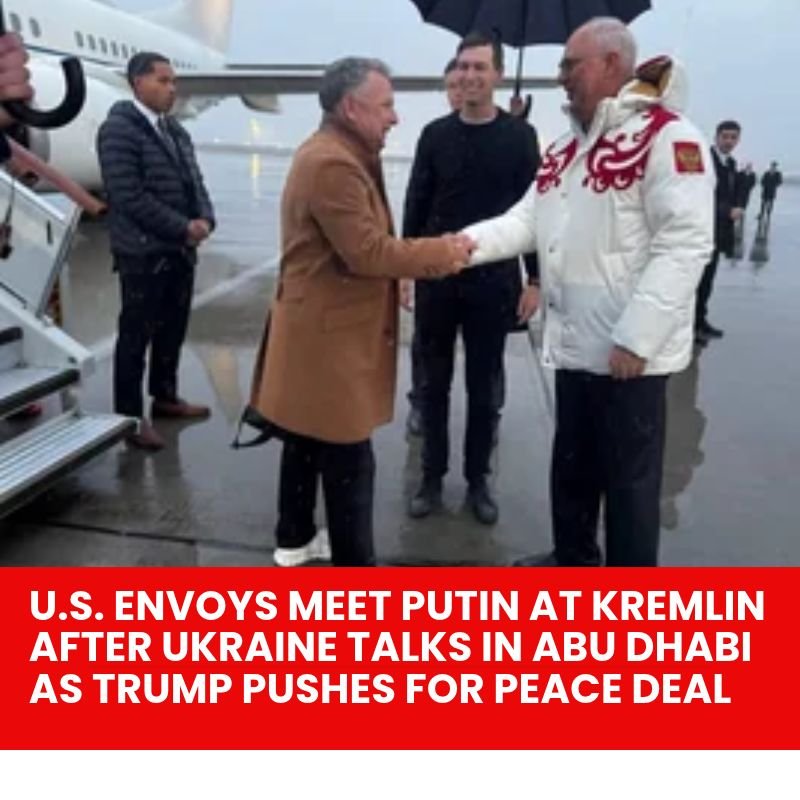
U.S. President Donald Trump’s special envoy Steve Witkoff and his son-in-law Jared Kushner met Russian President Vladimir Putin at the Kremlin on Thursday, November 12, 2026, as Washington attempted to revive diplomatic efforts to end the war in Ukraine.
The meeting in Moscow followed two days of U.S.-mediated negotiations between Russian and Ukrainian delegations in Abu Dhabi, United Arab Emirates. Although the discussions produced an agreement on a major prisoner exchange, negotiators failed to announce a breakthrough on the central issues keeping the conflict alive.
The Kremlin meeting was an important step in Washington’s latest diplomatic effort. However, disagreements over occupied Ukrainian territory, European involvement and future security arrangements continue to complicate negotiations.
Putin Meets Trump’s Envoys After Abu Dhabi Negotiations
Witkoff and Kushner traveled directly to Moscow after participating in the Abu Dhabi discussions. Their meeting with Putin lasted approximately two hours, according to Associated Press reporting.
The U.S. representatives wanted to brief the Russian president on the latest proposals and explore whether the discussions could move closer to a broader agreement.
Kushner and Witkoff had helped facilitate the negotiations between Russian and Ukrainian representatives in the United Arab Emirates. The Abu Dhabi meetings were the first direct discussions between the two sides in nine months.
The negotiations focused on possible steps toward ending the war, postwar security arrangements and issues that would need to be resolved before a lasting settlement could become possible.
However, the discussions revealed that Russia and Ukraine remain far apart on several major questions.
Prisoner Exchange Becomes the Main Development
One of the most significant outcomes from the Abu Dhabi negotiations was an agreement to arrange a large prisoner exchange.
Kushner described the proposed exchange as the biggest of its kind, although officials had not announced the exact number of prisoners involved at the time of the initial reports.
The agreement offered a practical result from discussions that otherwise produced limited progress.
Russia and Ukraine have completed prisoner exchanges during earlier stages of the war. Such arrangements have allowed detained military personnel to return home even while broader diplomatic negotiations remained stalled.
Ukrainian President Volodymyr Zelenskyy welcomed the proposed exchange as a positive development. However, he continued to reject any settlement that would require Ukraine to surrender territory occupied by Russian forces.
The prisoner agreement could help maintain diplomatic communication, but it does not resolve the central political and territorial disagreements.
Why the United States Wants Europe Included in Peace Talks
Another major issue surrounding the negotiations is the role of European countries in discussions about Ukraine’s future security.
Kushner said one objective of the meeting with Putin was to seek Russian acceptance of European participation in future negotiations.
Washington and Kyiv want European countries to appoint a single representative who could take part in discussions with Moscow. The proposal reflects the importance of European security interests in any agreement concerning Ukraine.
European governments have provided military, financial and humanitarian support to Ukraine since Russia launched its full-scale invasion in February 2022. They would also have a significant role in supporting Ukraine’s recovery and security after a potential ceasefire.
However, Moscow has expressed opposition to European involvement in direct negotiations. Russian officials argue that European countries are supporting Ukraine’s military campaign by supplying weapons and providing financial assistance.
This disagreement creates another challenge for U.S. negotiators.
Moscow and European Governments Have Different Security Priorities
Russia wants discussions about a broader European security arrangement to address its long-standing objections to NATO’s expansion.
Putin has repeatedly described NATO’s eastward expansion as a security threat to Russia. Moscow has also demanded changes to the alliance’s military presence near Russian borders.
European governments, meanwhile, remain concerned about Russia’s military actions and its intentions toward neighboring countries.
Many European leaders believe discussions about Europe’s future security cannot take place without meaningful progress toward ending the fighting in Ukraine.
Some European officials are also concerned that negotiating directly with Moscow about the continent’s security could give Russia greater influence over decisions involving countries that are not part of the conflict.
The United States is attempting to bring these competing concerns into a diplomatic framework. However, the disagreement over who should participate in negotiations remains unresolved.
Putin Rejects European Troops in Ukraine After a Ceasefire
During the Kremlin meeting, Putin reiterated Russia’s opposition to European troops being deployed in Ukraine after a possible ceasefire.
He warned that Moscow would consider such forces a security threat and legitimate targets. Putin also said that the presence of European troops could lead to the immediate resumption of fighting.
The statement highlights one of the most difficult questions facing negotiators: how Ukraine can receive security guarantees without triggering another confrontation with Russia.
Ukraine wants assurances that Russia will not launch another invasion after a peace agreement. European governments have also discussed possible security arrangements that could help protect Ukraine in the future.
Russia, however, has repeatedly objected to the deployment of NATO forces or other Western military personnel in Ukraine.
Territorial Disputes Remain a Major Obstacle
The future of Ukrainian territory occupied by Russia remains one of the biggest barriers to a settlement.
Russia claimed to annex four Ukrainian regions in 2022: Donetsk, Luhansk, Zaporizhzhia and Kherson. However, Russian forces have never fully controlled all the territory within those regions.
Moscow continues to insist on its claims over these areas, while Ukraine rejects Russia’s annexations as illegal and refuses to recognize the occupied territories as Russian.
Putin reiterated Russia’s position during the Kremlin discussions, including its claim that the four regions should be treated as part of Russian territory under a potential peace arrangement.
Kyiv has rejected demands that it surrender the entire eastern Donbas region as a condition for ending the war.
This disagreement makes it difficult for negotiators to develop a settlement acceptable to both governments. Any proposal involving territorial changes would also face serious political and public challenges inside Ukraine.
What Happens After the Kremlin Meeting?
Following the meeting with Putin, Kushner and Witkoff were expected to travel to Dublin, Ireland, for further discussions with Zelenskyy.
The Ukrainian president was attending a gathering of more than 40 European countries focused on the continent’s political and security challenges.
The planned meeting would give the U.S. representatives an opportunity to brief Zelenskyy on their discussions with Putin and examine whether any proposals could move forward.
The diplomatic sequence is important because Washington is attempting to maintain communication with both governments rather than relying on a single negotiating track.
However, the United States still faces the challenge of reconciling Russia’s demands with Ukraine’s position on sovereignty, territorial integrity and long-term security.
Why the Latest Talks Matter for the Ukraine War
The November negotiations represent a renewed diplomatic effort after months without direct discussions between Russian and Ukrainian delegations.
The war has continued to affect civilians, military personnel, infrastructure and economic activity across Ukraine. Attacks on energy facilities and other infrastructure have added pressure as the region approaches another winter.
A ceasefire could reduce immediate humanitarian risks, but negotiators would still need to address the conditions required to prevent renewed fighting.
These questions include territorial control, security guarantees, military deployments, reconstruction and the future relationship between Russia and European countries.
The prisoner exchange agreement demonstrates that limited cooperation remains possible. However, progress on humanitarian arrangements does not necessarily mean that a comprehensive peace agreement is close.
Key Challenges Still Facing the Negotiators
The latest diplomatic discussions have highlighted several unresolved issues:
- Territory: Russia and Ukraine disagree over the future of occupied Ukrainian regions, particularly Donbas.
- Security guarantees: Kyiv wants assurances against another Russian invasion.
- European participation: The United States and Ukraine want European representatives included in future discussions, while Moscow remains opposed to their direct involvement.
- Military deployments: Russia rejects the possibility of European troops operating in Ukraine after a ceasefire.
- Prisoner exchange: Officials still need to finalize the details and number of people involved in the proposed exchange.
These challenges will influence whether the diplomatic process can move beyond limited agreements toward a wider settlement.
International Diplomacy Faces a Difficult Test
The Kremlin meeting brought Washington’s latest peace initiative directly to Putin, but it did not immediately resolve the disagreements that have prevented an agreement for years.
The United States is trying to create a negotiating framework that addresses Russian security concerns while protecting Ukraine’s sovereignty and involving European partners.
Those objectives will be difficult to balance. Moscow, Kyiv and European governments have different expectations about what a postwar settlement should look like.
What to Watch Next
The next important developments will include the outcome of the planned U.S. discussions with Zelenskyy in Dublin, the final details of the prisoner exchange and whether Russia accepts a larger European role in negotiations.
For now, the Abu Dhabi talks and Kremlin meeting have reopened diplomatic channels, but the war remains unresolved.
The latest discussions show that negotiations are continuing. Whether they can produce a lasting ceasefire or peace agreement will depend on progress over territory, security guarantees and the future role of Europe in Ukraine’s security.
Sources and further reading:
- Associated Press: https://apnews.com/article/683810203340077f33611fd1d1757b23
- Reuters coverage: https://www.themoscowtimes.com/2026/11/12/us-envoys-arrive-in-moscow-for-latest-round-of-talks-with-putin-a94236
- The Washington Post: https://www.washingtonpost.com/world/2026/11/11/russia-ukraine-agree-prisoner-swap-little-else-us-mediated-talks/
- NPR: https://www.npr.org/2026/11/12/nx-s1-6037558/u-s-officials-set-to-meet-with-putin-zelenskyy-following-abu-dhabi-peace-talks