
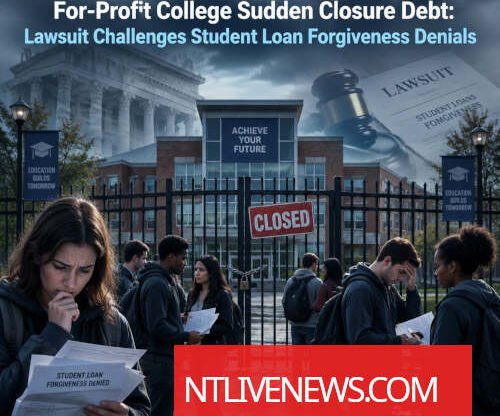

Business updates USA: For-profit college sudden closure debt is back in the spotlight after a new lawsuit accused the U.S. Department of Education of refusing to fully implement student loan discharge protections for borrowers whose schools abruptly shut down.
Filed on October 28, 2026, the federal lawsuit argues that thousands of former students could be affected by the government’s handling of a policy designed to help borrowers left without their degrees.
The case centers on federal student loan forgiveness, closed school discharge eligibility, and a dispute over expanded protections introduced during the final days of the Biden administration.
For affected borrowers, the dispute raises an important question: Can students still be responsible for education debt when their college closes before they finish their degree?
For-Profit College Sudden Closure Debt: Why the Lawsuit Matters
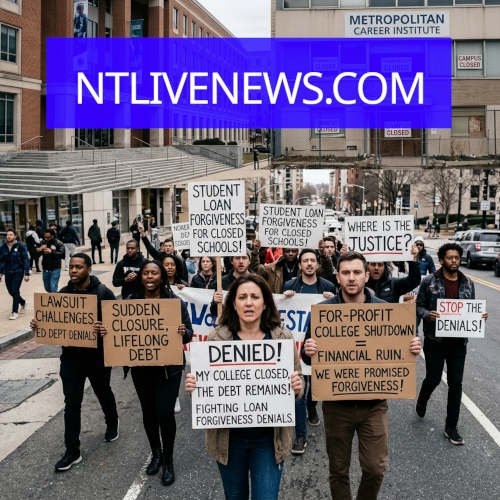
The lawsuit was filed by Student Defense, a nonprofit organization that advocates for students and borrowers.
It represents Kendrick Gaussoin, a former student at Brooks Institute in Ventura, California. His story illustrates how a college closure can leave students with substantial debt and no completed qualification.
Brooks Institute abruptly closed in August 2016. Gaussoin had been pursuing a bachelor’s degree in photography when he discovered that the campus doors had been chained shut.
He had taken an eight-month leave of absence to work as a photographer. Because he was away from school for too long under the standard eligibility rules, he initially did not qualify for a closed school discharge.
A policy change in January 2025 appeared to offer him another opportunity to obtain relief.
However, after applying in August 2026, Gaussoin received a denial letter. The Education Department said he did not satisfy the traditional eligibility requirements.
The new lawsuit challenges the administration’s handling of the expanded eligibility policy.
Student Defense argues that the government cannot simply disregard the earlier change without providing a legally sufficient explanation.
The Education Department, meanwhile, says it stands by its implementation of the program.
What Is Closed School Loan Discharge?
Closed school loan discharge is a federal student loan relief program for eligible borrowers whose educational institutions shut down before they could complete their studies.
Unlike a standard student loan repayment plan, a discharge can eliminate qualifying federal education debt.
Depending on eligibility, it may also provide a refund of payments previously made toward discharged loans.
The program is particularly important for students who paid tuition, borrowed money, and lost access to their education when their colleges closed.
However, not every borrower whose college closes automatically qualifies for student loan forgiveness.
Eligibility depends on factors such as enrollment status, the timing of the school’s closure, the type of loan, and whether the student completed or transferred to a comparable program.
The official application and eligibility information is available through the Federal Student Aid website.
How Many Borrowers Have Been Affected by College Closures?
College closures have created substantial financial challenges for students across the United States.
A September 2021 report from the U.S. Government Accountability Office (GAO) examined borrowers affected by college closures between 2010 and 2020.
The report found that approximately 246,000 borrowers had been enrolled at more than 1,100 colleges that closed during that period.
Around 43% of affected borrowers neither completed their programs before closure nor transferred to another college.
More than 80,000 borrowers had received closed school loan discharges by the time covered by the report.
These findings demonstrate the scale of the problem.
Students can lose access to their education while remaining responsible for tuition-related debt. Some may also need to pay additional tuition to complete their qualifications elsewhere.
The GAO findings are historical figures covering 2010–2020, not a current count of all borrowers awaiting relief in 2026.
Why Did the Biden Administration Expand Loan Discharge Eligibility?
Under the traditional rules described in the lawsuit, borrowers generally had to be enrolled when their school closed or to have withdrawn within a specified period before the closure.
The policy also recognizes certain approved leaves of absence.
For Gaussoin, the timing of his leave from Brooks Institute became a major obstacle.
He left the institution in December 2015 and returned as the school was approaching its August 2016 closure. His absence placed him outside the standard eligibility window.
On January 6, 2025, the Education Department expanded the eligibility period for borrowers associated with several closed institutions, including Brooks Institute.
Under that change, borrowers enrolled as of May 6, 2015, could qualify for discharge and refunds of previous payments.
The expanded policy gave Gaussoin a potential route to relief despite his earlier leave of absence.
However, the change became a point of disagreement following the presidential transition.
The current lawsuit argues that the government must follow the applicable policy unless it lawfully changes or withdraws it.
The dispute now places the administration’s interpretation of federal student loan rules under legal scrutiny.
Why Is the Education Department Denying Some Applications?
According to reporting by NPR, Gaussoin applied for a closed school discharge on August 23, 2026.
The department denied his application on August 31, stating that he did not meet the traditional eligibility requirements.
The administration questioned the legality of the Biden-era expansion.
Education Department spokesperson Ellen Keast said the previous administration had improperly expanded the discharge period shortly before leaving office.
Student Defense disputes that position.
The organization argues that the expanded policy was adopted within the department’s legal authority and cannot simply be ignored.
Higher education attorneys interviewed by NPR also questioned whether the administration could disregard the change without providing a reasoned legal explanation.
The lawsuit seeks to challenge the government’s handling of the expanded eligibility rules.
The case does not mean that every former student from a closed college will automatically receive debt cancellation. Its outcome will depend on the legal claims and any resulting court decisions.
How Much Student Loan Debt Do the Former Students Owe?
Gaussoin’s case also highlights the long-term financial consequences of college closures.
According to NPR’s October 29 report, he still owed nearly $22,000 in student loan debt, including interest, despite not completing his degree at Brooks Institute.
His mother, Christine Gaussoin, also took out Parent PLUS loans to help pay for his education.
She reportedly owes approximately $28,000 and had also been denied a closed school discharge application.
Their experience demonstrates how education debt can affect an entire family.
Parent PLUS loans are federal loans that eligible parents can use to help pay for a dependent student’s education. Parents generally remain responsible for repaying these loans even when their child does not graduate.
For families who expected an educational investment to improve future earnings, a sudden college closure can create years of financial pressure.
Borrowers should therefore examine the specific loan types involved rather than assuming that a student’s discharge automatically eliminates a parent’s separate loan obligations.
What Should Borrowers Do After a For-Profit College Closes?
Students affected by a sudden college closure should review their federal student loan options as soon as possible.
The first step is to establish whether the institution and the student’s enrollment circumstances qualify for a closed school discharge.
Borrowers should gather enrollment records, withdrawal dates, approved leave-of-absence documents, loan statements, and any notices received from the college.
These records can help establish whether the borrower meets the standard eligibility criteria or may qualify under an expanded policy.
Students should also determine whether their loans are federal or private.
Federal student loans may qualify for closed school discharge under applicable federal rules. Private student loans generally do not receive the same federal discharge protection, although a lender may offer separate remedies.
Borrowers should avoid assuming that a college’s closure automatically stops loan payments.
Until a discharge or other applicable relief is confirmed, they should check their loan status and obtain guidance from their loan servicer or an appropriate legal aid organization.
Official information is available through Federal Student Aid.
Could the Lawsuit Change Student Loan Forgiveness Rules?
The lawsuit could have implications for borrowers who attended institutions covered by the expanded eligibility policy.
If the plaintiffs succeed, the court could require the government to reconsider its approach or comply with applicable legal obligations.
However, the precise outcome will depend on the court’s findings and the remedies requested or granted.
The case also highlights a broader issue in student loan policy: how federal agencies administer existing relief programs when administrations change.
Borrowers need clear rules, consistent decisions, and reliable information about their rights.
For students whose schools closed years ago, uncertainty can make it difficult to plan finances, repay loans, or determine whether they can seek refunds.
The lawsuit could help clarify the dispute over expanded closed school discharge eligibility, but no final outcome should be assumed before the legal process runs its course.
Frequently Asked Questions
1. What is for-profit college sudden closure debt?
It refers to education debt that students may still owe after a private, for-profit college abruptly shuts down. Eligible borrowers with federal student loans may qualify for a closed school discharge.
2. Can federal student loans be forgiven if a college closes?
Yes, eligible borrowers may qualify for a federal closed school discharge if they meet the applicable requirements. The closure alone does not guarantee automatic loan cancellation.
3. What is the October 2026 student loan lawsuit about?
Student Defense filed a lawsuit challenging the Education Department’s handling of expanded closed school discharge eligibility introduced in January 2025. The organization argues that the government cannot simply disregard the policy without proper legal justification.
4. Does a closed school discharge cover Parent PLUS loans?
Eligible federal Parent PLUS loans may qualify for discharge when the applicable requirements are met. Parents should check their own loan eligibility because a student’s application does not necessarily resolve a parent’s separate loan obligations.
5. Are private student loans forgiven when a college closes?
Private student loans generally are not covered by the federal closed school discharge program. Borrowers should review their loan agreements and contact their lenders about possible remedies.
6. How can I apply for closed school loan discharge?
Start by reviewing the official Federal Student Aid closed school discharge guidance. Check your eligibility, gather your education and loan records, and follow the current application instructions.
7. Will the lawsuit automatically erase student loan debt?
No. Filing a lawsuit does not automatically cancel borrowers’ debts. Any relief will depend on the legal proceedings, the applicable eligibility rules, and any court order or administrative action.
Conclusion
The dispute over for-profit college sudden closure debt highlights the financial risks students can face when an institution shuts down before they complete their education.
As of now, affected students and parents should verify their eligibility, preserve relevant records, and consult official federal guidance before making decisions about their loans.
The central issue remains whether borrowers who qualify under the applicable rules will receive the relief those rules provide.
Sources :