
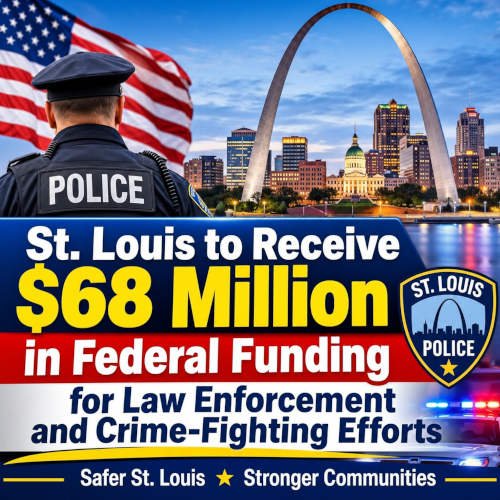
St. Louis, Missouri, will receive $68 million in federal funding to strengthen law enforcement, support police officers and expand crime-prevention services. The announcement was made on November 9, 2026, by U.S. Attorney General Todd Blanche during an event at Kiener Plaza in downtown St. Louis.
The funding comes through the Department of Justice’s (DOJ) Model Cities Initiative (MCI), a federal program designed to help selected communities reduce violent crime and improve public safety. St. Louis is one of four jurisdictions selected nationwide to receive money through the initiative.
The investment is expected to support police recruitment, officer compensation, police academy improvements, equipment upgrades and technology. It will also help expand services for people experiencing homelessness, victims of crime and residents who need crisis support.
The announcement places St. Louis among the communities receiving a significant federal investment in public safety. However, officials will still need to finalize the spending plan and determine how the money will be allocated across the city’s priorities.
Why Is St. Louis Receiving $68 Million in Federal Funding?
Attorney General Todd Blanche announced the $68 million award during a public event at Kiener Plaza on November 9. He was joined by Missouri Governor Mike Kehoe, U.S. Senator Eric Schmitt, Missouri Attorney General Catherine Hanaway, St. Louis Metropolitan Police Chief Robert Tracy and other officials.
The funding is intended to strengthen the city’s ability to address violent crime and improve coordination between local, state and federal agencies.
According to the announcement, St. Louis was selected from 47 cities that applied for the Model Cities Initiative. The Justice Department ultimately selected four jurisdictions: St. Louis, Jacksonville in Florida, Jackson in Mississippi and East Baton Rouge Parish in Louisiana.
The initiative provides nearly $300 million in federal resources to support comprehensive public safety strategies. Rather than focusing only on police enforcement, the program encourages cities to combine law enforcement resources with community partnerships and services that address factors contributing to crime.
Blanche described the investment as an opportunity to make St. Louis a model for modern crime-fighting strategies. The federal government expects the selected jurisdictions to work with local partners and demonstrate measurable improvements in public safety.
How Will the $68 Million Support Law Enforcement?
The funding is expected to address several operational needs within the St. Louis Metropolitan Police Department. These priorities include attracting new officers, improving working conditions and giving law enforcement personnel better tools to investigate and respond to crime.
Police recruitment and staffing: A portion of the funding is expected to support police recruitment and help the department attract additional officers. Recruitment resources can help address staffing challenges and strengthen the department’s ability to maintain an effective presence across neighborhoods.
Officer pay and support: The award is also expected to help support officer compensation. Competitive pay and recruitment incentives may help the department attract qualified candidates and retain experienced personnel.
Police academy improvements: Funding for academy improvements could strengthen training facilities and support the preparation of new officers. Training remains an important part of law enforcement because officers must be equipped to handle investigations, emergency calls, public interactions and changing public safety challenges.
Vehicles and equipment: The grant is expected to support upgrades to police vehicles and equipment. Modern equipment can help officers respond to emergencies, conduct investigations and perform their duties more effectively.
Technology and crime investigations: The initiative also allows funding for improved technology and investigative capabilities. These investments may help law enforcement agencies share information, analyze evidence and coordinate responses to violent crime.
The exact spending breakdown has not been publicly established in the announcement. The city and police department will work with the Justice Department to finalize the public safety plan and determine how the federal money will support individual projects.
What Is the Model Cities Initiative?
The Model Cities Initiative is a Department of Justice program designed to support selected American communities in reducing violent crime and improving public safety.
The DOJ announced the initiative in June 2026, describing it as a whole-of-city approach. This means local government leaders, law enforcement agencies and community partners are expected to work together rather than operate independently.
The federal government set aside nearly $300 million for the initiative. Four jurisdictions were selected after a competitive process that attracted applications from 47 cities.
The program is intended to support a combination of police resources, investigative technology, public safety partnerships and services addressing mental health, substance use and repeat offending.
The Justice Department says it will work with each selected jurisdiction to finalize and implement its public safety plan. The goal is to encourage locally developed strategies while strengthening coordination with federal and state partners.
Which Other Cities Were Selected for Federal Funding?
St. Louis is not the only jurisdiction receiving support through the program. Three other communities were selected for federal investment.
- Jacksonville, Florida: The city was selected through the initiative to strengthen law enforcement and improve public safety.
- East Baton Rouge Parish, Louisiana: The parish received more than $63.5 million through the program, according to the Justice Department’s November 5 announcement.
- Jackson, Mississippi: The city was also selected as one of the four jurisdictions.
- St. Louis, Missouri: The city was awarded $68 million, announced publicly by Attorney General Blanche on November 9.
The funding amounts are not identical for every jurisdiction. Each community submitted its own public safety strategy, and the Justice Department will work with local officials to implement the approved plans.
Community Services Will Also Receive Support
The St. Louis funding is not limited to police staffing, vehicles and equipment. The announcement also highlighted plans to expand community services through partnerships connected to law enforcement.
One important component is a law-enforcement-led homeless outreach program. The initiative is expected to bring officers and community service professionals together to connect people experiencing homelessness with appropriate assistance.
The planned services include social workers, victim advocates and partnerships with crisis support groups.
Homeless outreach: The program is expected to help law enforcement agencies connect people experiencing homelessness with community resources. Outreach can provide opportunities to identify individual needs and connect residents with support services.
Social workers: Social workers can help address situations involving housing instability, mental health concerns and other social challenges. Their involvement may also help officers respond more effectively when a situation requires social support rather than a traditional enforcement response.
Victim advocates: Victim advocates can help people affected by crime understand available services and access assistance. Their work may include connecting victims with support organizations and helping them navigate the process after a crime.
Crisis support partnerships: Collaboration with crisis support groups can help connect people in difficult situations with relevant services. These partnerships are intended to strengthen the community response to problems that may contribute to repeated emergency calls or interactions with law enforcement.
These services are an important part of the initiative’s broader approach. Public safety efforts can involve both crime prevention and assistance for people facing difficult circumstances.
What Did St. Louis Police Chief Robert Tracy Say?
St. Louis Metropolitan Police Chief Robert Tracy welcomed the federal investment and emphasized the importance of making residents feel safe in their neighborhoods.
During the announcement, Tracy said residents deserve to feel safe walking along their streets, opening their businesses and allowing their children to play outside.
His comments reflected the central objective of the funding: improving public safety while giving officers and community partners additional resources.
Senator Eric Schmitt also described the award as an investment in the safety of St. Louis residents. His office said the funding would help strengthen police recruitment, officer support, academy improvements and equipment.
The announcement builds on previous federal and local efforts to address violent crime in the city, including Operation Show-Me Justice, an ATF-led initiative mentioned by Schmitt’s office.
However, the $68 million award is a new investment through the Model Cities Initiative. Its long-term impact will depend on how effectively the approved projects are implemented and whether they produce measurable improvements.
When Will St. Louis Receive and Use the Federal Money?
The $68 million is a federal grant, not a loan. The funding is expected to be distributed over three years, according to remarks made during the November 9 announcement.
Officials indicated that the city and the Justice Department would spend the next month or two finalizing the plan for how the money will be used.
Residents should not assume that every project will begin immediately. The timing will depend on the final spending plan, administrative requirements and the implementation schedule for individual projects.
The announcement also indicated that residents could begin seeing results from some law enforcement efforts as early as the winter months of 2027.
The three-year funding period gives the city time to develop projects, improve police capabilities and expand partnerships. Progress will need to be assessed over time rather than judged only by the initial announcement.
What Could the Funding Mean for St. Louis Residents?
The federal investment could affect public safety in several ways. Additional recruitment resources may help the police department strengthen staffing, while equipment and technology upgrades could support investigations and emergency responses.
Community services may also provide additional assistance to people experiencing homelessness, victims of crime and residents facing crises.
However, receiving federal funding does not automatically guarantee a reduction in crime. The results will depend on how the money is spent, how agencies coordinate their work and whether the selected strategies address the city’s most pressing public safety needs.
Residents will also have an interest in understanding how the projects are selected, how spending is monitored and what results the city reports.
What Should Residents Watch Next?
The next important development will be the final public safety plan. That document should provide greater clarity about project priorities, spending decisions and the responsibilities of the participating agencies.
Residents may also want to follow updates from the St. Louis Metropolitan Police Department, city officials and the Department of Justice.
Important questions include how much money will go toward recruitment, which technology and equipment projects will receive priority, how the homeless outreach program will operate and how officials will measure progress.
The Bottom Line
St. Louis will receive $68 million in federal funding through the Department of Justice’s Model Cities Initiative to strengthen law enforcement and improve public safety. The award will support police recruitment, officer pay, academy improvements, equipment