
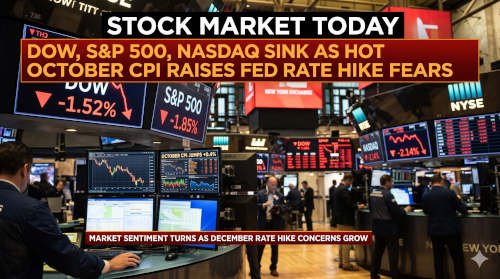
Wall Street came under pressure on Tuesday, November 10, 2026, as investors reacted to hotter-than-expected US inflation data and growing expectations of another Federal Reserve interest rate increase in December.
The Dow Jones Industrial Average, S&P 500 and Nasdaq Composite all declined in early trading after the October Consumer Price Index (CPI) report showed that consumer prices increased more than economists had forecast. The latest inflation figures raised concerns that the Federal Reserve may need to keep monetary policy restrictive for longer.
According to Yahoo Finance’s market update, the Dow was down approximately 0.33%, the S&P 500 declined 0.61%, and the Nasdaq Composite lost 0.76% at the reported snapshot. Nvidia shares also fell sharply, dropping approximately 3.85%.
The market reaction followed a difficult period for technology stocks and a strong rebound on Monday. Investors were particularly concerned that persistent inflation could lead to higher borrowing costs, putting pressure on stock valuations, corporate earnings and consumer spending.
Stock Market Today: How the Dow, S&P 500 and Nasdaq Performed
The major US stock indexes moved lower as traders reassessed the economic outlook following the latest inflation report.
The Dow Jones Industrial Average, which tracks 30 major American companies, declined as investors considered the possibility of higher interest rates. The S&P 500 also moved lower, reflecting weakness across parts of the broader US equity market.
The technology-heavy Nasdaq Composite experienced additional pressure as investors reconsidered the outlook for growth stocks and major technology companies.
Here are the reported market movements from the Yahoo Finance update:
| Market Index or Stock | Reported Movement |
|---|---|
| Dow Jones Industrial Average | -0.33% |
| S&P 500 | -0.61% |
| Nasdaq Composite | -0.76% |
| Nvidia (NVDA) | -3.85% |
These figures represent the market snapshot reported in the update, not confirmed final closing performances. Stock prices and index levels can change throughout the trading session.
The decline followed a strong rally on Monday, when major US indexes recorded substantial gains. According to the Associated Press, the S&P 500 advanced 2.3%, the Dow climbed 2.2%, and the Nasdaq Composite gained 2.7% during the November 9 session.
The sharp contrast between Monday’s rally and Tuesday’s weakness illustrates how quickly investor sentiment can change when important economic data challenges expectations.
October CPI Report Pushes Inflation Concerns Back Into Focus
The October 2026 Consumer Price Index report became the main catalyst for Tuesday’s stock market decline.
The Bureau of Labor Statistics reported that the CPI increased 0.4% in October, compared with economists’ expectations of a 0.3% increase. Although the monthly increase slowed from September’s 0.6%, the latest figure was still stronger than expected.
Core CPI, which excludes volatile food and energy prices, increased 0.3% in October. Economists had expected a smaller 0.2% increase.
The latest figures indicate that inflation remains a significant concern for the US economy.
Key October inflation figures included:
- Headline CPI increased 0.4% month over month.
- Core CPI rose 0.3%.
- Food prices increased 0.5%.
- Energy prices climbed 0.7%.
- Shelter costs increased 0.3%.
The report did not include the usual year-over-year inflation figures because the 2025 federal government shutdown prevented the collection of October 2025 consumer price data.
That missing comparison makes it more difficult to assess annual inflation through the traditional CPI measure for October. However, the monthly figures still provided important information for investors and Federal Reserve policymakers.
For Wall Street, the bigger concern was that both headline and core inflation came in above expectations. Persistent price increases could make it harder for the Fed to reduce inflation without further tightening monetary policy.
Federal Reserve Rate Hike Bets Increase After Inflation Data
Expectations surrounding the Federal Reserve’s December interest rate decision played a major role in Tuesday’s market reaction.
Before the October CPI release, investors were already paying attention to comments from Federal Reserve Governor Christopher Waller. In a speech in London, Waller said he supported a 25-basis-point rate increase at the December meeting, even if October inflation improved.
He also warned that a larger increase could be necessary if inflation remained stubborn.
Waller said that if core consumer prices increased by 0.3% or more from September, policymakers should consider a 50-basis-point rate increase.
The actual October core CPI increase came in at 0.3%, meeting the threshold Waller had highlighted.
This added to market concerns about a potentially more aggressive Federal Reserve response.
According to Reuters, financial markets had already been assigning a high probability to a December rate increase. After the latest inflation report and Waller’s comments, expectations for additional monetary tightening became even stronger.
The Fed’s December 8–9 meeting will be closely watched by investors, businesses and American consumers.
Why a Federal Reserve Rate Hike Matters for Stocks
Higher interest rates can create several challenges for the stock market.
First, borrowing becomes more expensive for companies. Businesses that depend on loans or external financing may face higher interest expenses, potentially reducing profits.
Second, higher interest rates can affect consumer spending. When credit card, auto loan and mortgage costs rise, households may have less money available for discretionary purchases.
Third, higher Treasury yields can make fixed-income investments more attractive compared with stocks. This may encourage some investors to reduce exposure to equities, particularly expensive growth stocks.
Technology companies can be especially sensitive to changes in interest rate expectations because their valuations often depend on projected earnings and future growth.
However, a rate increase does not automatically mean stocks will continue falling. Corporate earnings, economic growth, inflation trends and investor expectations also influence market performance.
Nvidia Stock Falls as Technology Shares Face Pressure
Nvidia was among the notable stocks under pressure during Tuesday’s trading session.
The Yahoo Finance update showed Nvidia shares falling approximately 3.85%. The decline added to concerns about the technology sector, which has experienced volatility amid questions about artificial intelligence spending, company valuations and future growth.
Nvidia remains an important company for investors because its graphics processing units are widely used in artificial intelligence infrastructure, data centers and advanced computing systems.
Its stock performance can influence sentiment across the semiconductor industry and broader technology market.
The recent volatility in AI-related stocks has also raised questions about whether valuations have moved too far ahead of the earnings and cash flows that companies can realistically deliver.
Higher interest rate expectations can intensify these concerns. When investors demand a higher return to compensate for risk, companies whose valuations depend heavily on future growth may face additional selling pressure.
Still, Nvidia’s daily share price movement should not be treated as proof that demand for artificial intelligence technology is weakening. Investors will continue to examine earnings, chip demand, data-center spending and guidance from major technology companies.
Why the Stock Market Fell After Monday’s Strong Rally
Tuesday’s market decline followed a significant recovery during the previous trading session.
On November 9, US stocks recorded strong gains as investors responded to falling oil prices and renewed interest in technology shares.
The S&P 500 gained 2.3%, the Dow rose 2.2%, and the Nasdaq Composite advanced 2.7%, according to the Associated Press.
However, Tuesday’s inflation report changed the market’s immediate focus.
Before the CPI release, investors had been hoping that inflation would cool enough to reduce pressure on the Federal Reserve. Instead, the 0.4% monthly increase came in above forecasts.
The result was a shift toward concerns about tighter monetary policy.
Investors also had to consider the possibility that the Fed could raise rates even if some economic indicators begin to weaken. That creates uncertainty for companies planning investments, hiring and expansion.
Market sentiment can therefore change rapidly when inflation data, central bank comments and corporate developments arrive close together.
US Treasury Yields and the Dollar Add to Market Pressure
Treasury yields are another important factor for investors watching the stock market.
When traders expect the Federal Reserve to raise interest rates, short-term government bond yields can increase as markets adjust to the possibility of tighter monetary policy.
Reuters reported that Treasury yields moved higher following Waller’s comments about the need for additional rate increases.
Higher Treasury yields can affect stock valuations because investors use government bond returns as a reference when assessing the potential return from equities.
The US dollar may also respond to expectations of higher interest rates. If US assets offer more attractive yields, international investors may increase demand for dollar-denominated investments.
However, currency and bond market movements depend on several factors, including global economic conditions, central bank decisions and geopolitical developments.
For investors, monitoring Treasury yields alongside the Dow, S&P 500 and Nasdaq can provide a broader picture of how financial markets are responding to inflation.
What Investors Should Watch Next
The October CPI report has made upcoming economic releases and Federal Reserve communications especially important.
Investors will be watching several developments before the December policy meeting.
1. Upcoming inflation reports
Future CPI and Personal Consumption Expenditures (PCE) inflation data will help show whether price pressures are easing or becoming more widespread.
2. Federal Reserve comments
Statements from Fed officials could provide further clues about the likely size and timing of any December interest rate increase.
3. Treasury yields
Changes in short-term and long-term Treasury yields may influence stock valuations, borrowing costs and investor demand for equities.
4. Technology earnings
Investors will continue to assess earnings and guidance from major technology and semiconductor companies, particularly those benefiting from artificial intelligence spending.
5. Consumer spending and employment
Household spending and labor market data will help investors evaluate whether higher borrowing costs are beginning to affect economic activity.
The combination of inflation, interest rate expectations and corporate earnings will likely remain central to the market outlook during the coming weeks.
Frequently Asked Questions About the Stock Market Today
Why did the Dow Jones fall on November 10, 2026?
The Dow declined after October inflation increased more than economists expected. The report strengthened expectations that the Federal Reserve could raise interest rates in December.
Why did the S&P 500 and Nasdaq fall?
Investors reacted to higher inflation and the possibility of tighter monetary policy. Technology stocks also faced pressure as traders reassessed valuations and borrowing costs.
What was the October 2026 CPI increase?
The Consumer Price Index increased 0.4% in October, above economists’ forecast of 0.3%. Core CPI increased 0.3%.
Could the Federal Reserve raise interest rates in December 2026?
Yes. Markets increasingly expected a December increase following the inflation report and comments from Fed Governor Christopher Waller. However, the final decision will depend on the Federal Open Market Committee.
Why did Nvidia stock fall?
Nvidia shares declined during Tuesday’s trading session amid broader technology market weakness and investor concerns about inflation, interest rates and AI stock valuations.
When is the next Federal Reserve meeting?
The Federal Reserve’s next scheduled policy meeting is December 8–9, 2026.
Final Outlook: Inflation and Fed Policy Remain Wall Street’s Biggest Concerns
The US stock market faced renewed selling pressure on November 10 as stronger-than-expected October inflation figures increased concerns about another Federal Reserve rate hike.
The Dow Jones Industrial Average, S&P 500 and Nasdaq Composite all declined in the reported market snapshot, while Nvidia shares recorded a sharper loss.
For investors, the central issue is whether inflation will remain high enough to force the Fed to tighten monetary policy further. A December rate increase could influence Treasury yields, corporate borrowing costs, technology valuations and consumer spending.
The market’s next direction will depend on incoming economic data, Federal Reserve guidance and company earnings. Until investors have greater clarity on inflation and interest rates, volatility could remain an important feature of the US stock market.