
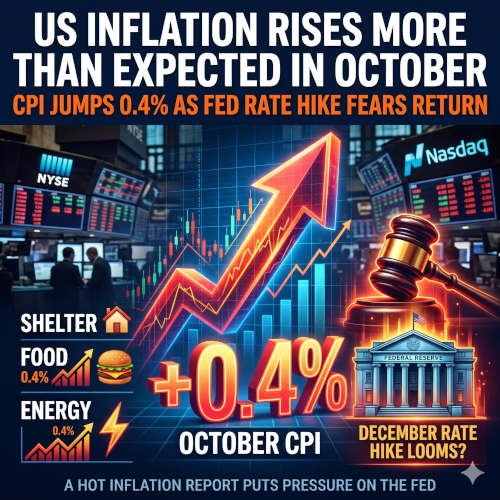
US inflation increased more than economists expected in October 2026, raising fresh concerns about the cost of living and the Federal Reserve’s fight against rising prices. The Consumer Price Index (CPI) climbed 0.4% during the month, compared with economists’ expectations of a 0.3% increase, according to the latest report from the Bureau of Labor Statistics (BLS).
Although the monthly inflation increase slowed from September’s 0.6%, the latest figures show that price pressures remain persistent across several parts of the American economy. Grocery prices, energy costs, housing expenses and other everyday services continued to put pressure on household budgets.
The report could also complicate the Federal Reserve’s interest rate decisions ahead of its December meeting. Investors are watching closely because inflation remains above the central bank’s 2% target, while higher borrowing costs could create additional pressure for consumers and businesses. Bureau of Labor Statistics
October 2026 CPI Report: What the Latest Inflation Numbers Show
The October Consumer Price Index increased 0.4% on a seasonally adjusted basis, following a 0.6% rise in September. Economists surveyed by Reuters had expected monthly inflation to increase by 0.3%.
The core Consumer Price Index, which excludes volatile food and energy prices, increased 0.3% in October. That matched its September increase but exceeded economists’ forecast of 0.2%.
The latest report indicates that inflationary pressure is not limited to gasoline or food. Housing, medical care, motor vehicle insurance and other services also recorded increases.
Here are the key figures from the October CPI report:
| Inflation Measure | October 2026 | September 2026 |
|---|---|---|
| Headline CPI | +0.4% | +0.6% |
| Core CPI | +0.3% | +0.3% |
| Food prices | +0.5% | 0.0% |
| Energy prices | +0.7% | +5.2% |
| Shelter costs | +0.3% | +0.4% |
One important limitation affects this month’s report. The BLS did not publish the usual year-over-year inflation figures because the 2025 federal government shutdown prevented the collection of October 2025 consumer price data. Without that comparison period, the agency could not calculate the standard 12-month inflation rate for October 2026. Bureau of Labor Statistics
Grocery Prices and Food Costs Continue to Increase
Food prices increased 0.5% in October after remaining unchanged in September. The increase matters for American households because groceries and restaurant meals represent regular expenses that families cannot easily avoid.
The food-at-home index, which measures grocery prices, increased 0.4%. Food-away-from-home prices, including restaurant meals, rose 0.5%.
Several grocery categories recorded increases:
- Meat, poultry, fish and eggs increased 0.5%.
- Beef prices rose 0.9%.
- Fruits and vegetables increased 0.6%.
- Dairy and related products climbed 0.6%.
- Other food-at-home prices increased 0.7%.
- Snack prices rose 1.0%.
Restaurant prices also moved higher. Full-service meals increased 0.7%, while limited-service meals rose 0.4%.
These figures suggest that consumers continued to face higher food expenses even as the overall monthly CPI increase slowed from September.
For families managing household budgets, higher grocery and restaurant prices can reduce the money available for savings, debt payments, transportation and other expenses. Bureau of Labor Statistics
Energy Prices Rise Again After September’s Sharp Increase
Energy prices increased 0.7% in October, following a much larger 5.2% increase in September.
Gasoline prices rose 1.0% on a seasonally adjusted basis after jumping 9.1% in September. Electricity prices increased 0.9%, while fuel oil climbed 2.0%.
Natural gas prices moved in the opposite direction, declining 0.8% during the month.
Energy costs remain an important part of the inflation picture because they affect more than household utility bills. Higher fuel prices can increase transportation and delivery expenses, potentially adding costs for businesses that move products across the country.
Reuters reported that higher oil prices linked to the US-Israeli conflict with Iran, together with import tariffs implemented by the Trump administration, have contributed to broader cost-of-living pressures. These developments form part of the economic backdrop behind the latest inflation figures. Bureau of Labor Statistics
Housing and Shelter Costs Remain a Major Inflation Factor
Housing expenses continued to contribute to monthly inflation in October.
The shelter index increased 0.3%, accounting for more than 30% of the monthly increase in the overall CPI, according to the BLS.
Within the category, owners’ equivalent rent increased 0.3%, while the rent index rose 0.2%. Lodging away from home, which includes hotel and similar accommodation costs, increased 0.6%.
Housing costs are particularly important because shelter represents a substantial share of household spending. Rent increases can affect families even when other consumer prices become more stable.
For people planning to buy a home, persistent inflation can also influence mortgage affordability. If inflation remains elevated, the Federal Reserve may have less room to reduce interest rates, potentially keeping borrowing costs higher for longer.
However, mortgage rates do not move in direct lockstep with the federal funds rate. They are also influenced by Treasury yields, inflation expectations and conditions in financial markets.
Why the Federal Reserve Is Watching Inflation Closely
The October CPI report arrives at a sensitive time for US monetary policy. The Federal Reserve has a long-term inflation target of 2%, and the latest figures suggest that price pressures remain above that level.
The central bank uses interest rates to influence borrowing, spending and investment. When inflation remains too high, policymakers may keep interest rates elevated or consider additional increases to help slow demand.
Higher interest rates generally make borrowing more expensive for households and businesses. Credit card balances, auto loans, business financing and some other forms of borrowing can become more costly.
The October inflation report strengthened expectations that the Federal Reserve could raise interest rates in December, according to Reuters. However, the central bank has not made that decision, and the final outcome will depend on incoming economic data and policymakers’ assessment of inflation and employment. Reuters
Could the Fed Raise Interest Rates in December 2026?
A December rate increase is one possibility investors are considering after the latest inflation report.
The Federal Reserve will need to assess whether price increases are continuing across the economy or whether recent movements reflect temporary pressures in particular categories.
Policymakers will also consider employment conditions, consumer spending, wage growth and other economic indicators before deciding whether to adjust monetary policy.
A rate increase could help cool demand and reduce inflationary pressure over time. However, it could also make mortgages, business loans and other forms of financing more expensive.
For that reason, the Fed faces a difficult balancing act: controlling inflation without unnecessarily weakening economic growth or the labor market.
What Higher Inflation Could Mean for US Stock Markets
Higher-than-expected inflation can create uncertainty for investors because it may change expectations about future interest rates.
When markets anticipate higher borrowing costs, growth stocks and companies that rely heavily on financing can face additional pressure. Higher Treasury yields may also make bonds more attractive relative to some stocks.
The latest Reuters market analysis reported that the October inflation data contributed to falling US stock futures, rising Treasury yields and a stronger dollar. Gold prices also declined amid the market reaction. Reuters
However, market movements can reflect several factors at once. Investors will continue to monitor upcoming economic reports, corporate earnings and Federal Reserve comments before making decisions about the direction of financial markets.
Why the October 2026 Annual Inflation Rate Is Missing
One unusual feature of the October CPI release is the absence of the standard year-over-year inflation figure.
The BLS explained that it could not collect consumer price survey data for October 2025 because of a federal government shutdown caused by a lapse in appropriations.
As a result, the agency did not have the necessary October 2025 comparison data for most CPI categories. It therefore could not calculate the usual 12-month percentage changes for October 2026.
The previous available annual inflation reading was 3.7% in September 2026.
This missing figure does not mean inflation stopped increasing or that the government has no current price information. The BLS still published monthly changes using available data. The missing comparison simply limits the usual year-over-year assessment for this reporting period. Bureau of Labor Statistics
Will the Missing CPI Data Affect the Fed’s Inflation Assessment?
The missing October 2025 comparison creates a reporting limitation, but it does not eliminate all the information available to policymakers.
The BLS continues to publish monthly CPI changes, including headline and core inflation. Other economic indicators also help the Federal Reserve assess price pressures.
Reuters reported that the missing October 2025 data do not affect the calculation of the Personal Consumption Expenditures (PCE) price index, another inflation measure closely watched by the Fed.
The central bank therefore has other information available when evaluating progress toward its inflation target. Reuters
What American Consumers Should Watch Next
The October inflation report highlights why households should continue paying attention to grocery prices, gasoline costs, housing expenses and borrowing rates.
Consumers may find it useful to review monthly budgets, compare prices on regular purchases and monitor credit card and loan interest rates. Households considering major purchases may also want to understand how changing borrowing costs could affect their finances.
Investors, meanwhile, will be watching upcoming inflation releases and Federal Reserve announcements for signs that price pressures are easing.
The next BLS Consumer Price Index report, covering November 2026, is scheduled for December 10, 2026, at 8:30 a.m. Eastern Time. That release will provide another important update before the Federal Reserve’s next policy decision. Bureau of Labor Statistics
Frequently Asked Questions About US Inflation in October 2026
1. How much did US inflation increase in October 2026?
The Consumer Price Index increased 0.4% in October on a seasonally adjusted monthly basis, compared with a 0.6% increase in September.
2. Was October inflation higher than economists expected?
Yes. Economists surveyed by Reuters expected the CPI to increase 0.3%, but the actual monthly increase was 0.4%.
3. What was the core CPI increase in October 2026?
Core CPI, which excludes food and energy, increased 0.3% in October. Economists had expected a 0.2% increase.
4. Why did the BLS not publish annual inflation figures for October?
The BLS could not collect October 2025 consumer price data because of the federal government shutdown. Without the previous year’s comparison data, it could not calculate the standard 12-month inflation rate for October 2026.
5. Could the Federal Reserve raise interest rates in December 2026?
A December increase is a possibility being considered by financial markets following the stronger-than-expected inflation report. However, the Fed has not confirmed a rate increase.
6. When will the next US inflation report be released?
The BLS has scheduled the November 2026 CPI report for December 10, 2026, at 8:30 a.m. Eastern Time.
Final Outlook: Inflation Remains a Challenge for the US Economy
The October 2026 inflation report delivered another warning that price pressures remain persistent in the United States. Headline CPI increased 0.4%, above economists’ expectations, while core inflation rose 0.3%.
Higher food, energy and shelter costs continue to affect household budgets, while the missing year-over-year comparison makes it harder to assess the latest annual inflation trend using the usual CPI measure.
The figures have also increased attention on the Federal Reserve’s December policy meeting. Whether policymakers raise interest rates or maintain current levels will depend on the broader economic picture.
For American consumers, businesses and investors, the next inflation report could provide important clues about whether the cost-of-living pressures are finally easing or remain a major concern heading into 2027.