
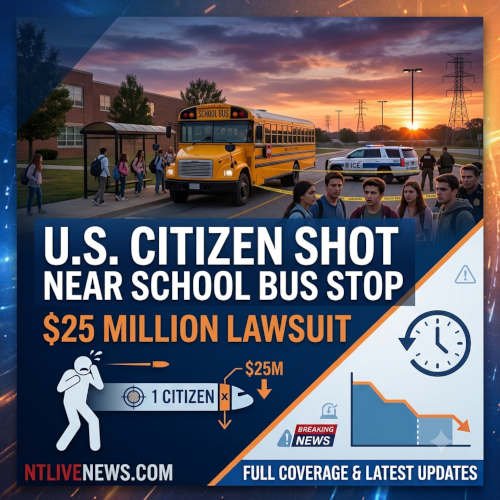
A U.S. citizen who was shot by an Immigration and Customs Enforcement (ICE) officer in Southern California has filed a lawsuit seeking more than $25 million in damages. The case involves a disputed 2025 shooting in Ontario, California, and allegations of excessive force, wrongful arrest and malicious prosecution.
Carlos Jimenez, a father of three, says he was driving to work at a food pantry on October 30, 2025, when he encountered federal immigration agents conducting an operation near his neighborhood. According to his lawsuit, he approached the officers to warn them that children would soon gather at a nearby school bus stop.
The complaint alleges that an ICE officer threatened Jimenez before shooting him as he attempted to turn his vehicle around and leave. Jimenez also accuses FBI agents of interfering with his medical treatment after the shooting.
Federal authorities have disputed his account. The Department of Homeland Security (DHS) previously said Jimenez reversed his vehicle toward officers and that the ICE agent fired defensive shots.
The lawsuit, filed on November 6, 2026, comes after federal prosecutors dismissed the criminal assault charge against Jimenez. The dismissal followed a diversion agreement between prosecutors and his defense attorneys. However, the criminal case’s dismissal did not establish that the shooting was unlawful or that federal agents committed misconduct. The Guardian
What Happened When Carlos Jimenez Encountered ICE Agents?
The incident happened around 7 a.m. on October 30, 2025, in Ontario, a city east of Los Angeles in San Bernardino County.
Jimenez was reportedly traveling to his job at a food pantry when he drove past ICE agents carrying out an immigration operation. His complaint says he noticed that children would soon be arriving at a nearby school bus stop.
According to the lawsuit, Jimenez approached the officers calmly to alert them about the children who would be gathering in the area.
The complaint identifies the ICE officer involved in the shooting as Eusebio Ortiz. It alleges that Ortiz pointed a firearm toward Jimenez’s face, used abusive language and threatened to shoot him if he did not leave.
Jimenez says he followed the officers’ instructions and attempted to make a three-point turn to leave the area. However, the lawsuit claims that federal vehicles blocked his path.
The complaint alleges that Ortiz then fired multiple shots into Jimenez’s vehicle without warning, striking him in the back and right shoulder.
Jimenez’s lawyers argue that he was trying to leave and did not pose a threat to the officers. They also claim that no officer was directly in the vehicle’s path when the shots were fired.
These details represent allegations in the civil complaint. The government’s account of the encounter is different, and the claims have not been resolved by a court. The Guardian
What Does the Government Say About the ICE Shooting?
The Department of Homeland Security previously presented a different explanation for the shooting.
A DHS spokesperson said Jimenez had attempted to run officers over by reversing directly toward them without stopping. The department described the officer’s gunfire as defensive shots taken because the officer believed he faced a threat.
Federal prosecutors subsequently charged Jimenez with assaulting a federal officer using a deadly or dangerous weapon.
The federal criminal complaint alleged that Jimenez rapidly accelerated his vehicle in reverse toward an officer during the encounter.
This account differs significantly from Jimenez’s description. His lawsuit argues that he was following instructions and attempting to leave when the ICE officer opened fire.
The distinction is central to the civil case because the court will need to consider the available evidence, including the officers’ accounts, communications, recordings and other relevant records.
Neither the federal government’s earlier allegations nor Jimenez’s claims in the civil lawsuit should be treated as established findings about the shooting. The Guardian
Jimenez Alleges FBI Agents Interfered With His Hospital Treatment
The lawsuit also raises questions about what happened after Jimenez was shot.
According to the complaint, FBI agents followed him to a hospital where he sought medical treatment. Jimenez alleges that the agents interfered with his care by pulling a nurse away and preventing him from speaking with medical staff.
The complaint further claims that agents removed him from his hospital bed, placed him in a waist restraint and transported him back to the shooting location for questioning.
Jimenez alleges that this happened while he was still seriously injured and had a bullet lodged in his body.
The lawsuit describes his condition during the journey, claiming that he was bleeding and vomiting inside the agents’ vehicle. It also alleges that officers told him not to damage the vehicle.
These allegations have not been independently established through a court ruling. The FBI declined to comment on the lawsuit, according to The Guardian.
Jimenez’s legal team is seeking damages related to the shooting, his alleged treatment by federal agents, medical expenses and lost income. The complaint also says bullet fragments remain lodged near his lung. The Guardian
Federal Assault Charges Against Jimenez Were Dismissed
The civil lawsuit follows the dismissal of the federal criminal case against Jimenez.
After the October 2025 shooting, federal prosecutors charged him with assaulting a federal officer using a vehicle as a dangerous weapon. A federal grand jury later indicted him.
His defense attorneys challenged the government’s account and sought records connected to the incident, including communications involving the officers.
The dispute over records became an important part of the criminal proceedings. In May 2026, U.S. District Judge Kenly Kiya Kato ordered the government to produce relevant communications. The order also required the government to provide a sworn statement from Ortiz if no responsive messages or emails could be found.
Prosecutors and Jimenez’s attorneys subsequently reached a diversion agreement. Under the arrangement, Jimenez agreed to meet certain conditions, and prosecutors could seek dismissal of the criminal case after he completed them.
The charges were formally dismissed in early November 2026.
The Justice Department offered its own explanation for the outcome. Department spokesperson Ciaran McEvoy told the Los Angeles Times that Jimenez had requested the diversion arrangement and that prosecutors sought dismissal after he complied with its conditions.
The department also said a grand jury had found probable cause to indict him.
The dismissal therefore ended the criminal prosecution under the agreement, but it did not amount to a judicial finding that the ICE officer unlawfully shot Jimenez. Los Angeles Times
Why the Lawsuit Raises Questions About Federal Accountability
Jimenez’s civil lawsuit accuses federal agents of excessive force, assault, false arrest and malicious prosecution.
It also alleges that investigators misrepresented witness statements. According to the complaint, the FBI claimed that two neighbors had witnessed the incident and told investigators Jimenez had enough room to drive forward rather than reverse.
Jimenez’s legal team says it later interviewed the neighbors, who allegedly denied making those statements and said they had learned about the shooting from news reports.
The lawsuit further claims that prosecutors pursued the diversion agreement to avoid producing officers’ communications and allowing an FBI agent to be questioned under oath.
These are serious allegations, but they remain claims made by Jimenez and his lawyers. The civil proceedings will provide an opportunity for the parties to present evidence and respond to the accusations.
The Justice Department has disputed the suggestion that the diversion agreement was designed to conceal evidence. Its spokesperson told the Los Angeles Times that Jimenez requested the arrangement and that the department followed the agreement after he completed its requirements.
The difference between the two accounts is likely to remain an important issue as the civil case moves forward. The Guardian
What Happens Next in the $25 Million ICE Lawsuit?
Jimenez is seeking more than $25 million in damages from the federal government and other defendants named in the complaint.
The lawsuit seeks compensation for alleged civil rights violations, medical expenses, lost wages and other damages connected to the shooting and subsequent prosecution.
DHS declined to comment on the lawsuit and referred questions to the Justice Department. The FBI also declined to comment, according to The Guardian.
The filing does not mean Jimenez has already won compensation. The defendants will have an opportunity to respond, and the claims will need to be addressed through the legal process.
The case could bring additional attention to federal immigration enforcement practices, particularly the use of force during operations in residential neighborhoods.
It also raises questions about how federal agencies document encounters, preserve officer communications and investigate allegations involving the use of firearms.
For now, the central issue remains unresolved: whether the shooting and the actions that followed violated Jimenez’s legal rights.
Frequently Asked Questions
1. Who is Carlos Jimenez?
Carlos Jimenez is a U.S. citizen and father of three from Ontario, California. He was shot by an ICE officer during a federal immigration operation on October 30, 2025.
2. Why is Carlos Jimenez suing the federal government?
Jimenez alleges that an ICE officer used excessive force, wrongfully shot him and that federal agents subsequently subjected him to false arrest and malicious prosecution. He is seeking more than $25 million in damages.
3. Where did the ICE shooting happen?
The shooting happened in Ontario, California, a city east of Los Angeles in San Bernardino County.
4. Did the ICE officer face a criminal charge?
The federal criminal case described in the reporting was brought against Jimenez, not the ICE officer. The civil lawsuit makes allegations against federal personnel, but those claims have not been decided.
5. Were the criminal charges against Jimenez dismissed?
Yes. Federal prosecutors dismissed the assault charge in November 2026 after Jimenez completed a diversion agreement.
6. Does the dismissal prove that ICE used excessive force?
No. The dismissal ended the criminal prosecution against Jimenez under the agreement. It did not establish that the shooting was unlawful or that federal agents committed misconduct.
7. How much compensation is Jimenez seeking?
Jimenez is seeking more than $25 million in damages, including compensation related to medical expenses, lost wages and alleged civil rights violations.
Final Takeaway
The $25 million lawsuit filed by Carlos Jimenez puts a disputed ICE shooting in Southern California back in the spotlight. Jimenez says he was trying to warn officers about children approaching a nearby school bus stop when he was shot. Federal authorities have maintained that the officer fired defensively after Jimenez allegedly reversed toward officers.
With the criminal charges now dismissed and the civil lawsuit moving forward, the legal questions surrounding the October 2025 encounter remain unresolved. The case will depend on the evidence presented and the court’s assessment of the competing accounts.
Sources and Further Reading
- The Guardian – U.S. citizen shot by ICE officer near children’s bus stop sues government
- Los Angeles Times – Assault charge dropped against U.S. citizen ICE allegedly shot from behind
Editorial note: This report distinguishes allegations in Jimenez’s lawsuit from the federal government’s account. The $25 million figure is the amount sought, not an awarded settlement. The criminal charge dismissal is not a finding of wrongdoing by the officers.