
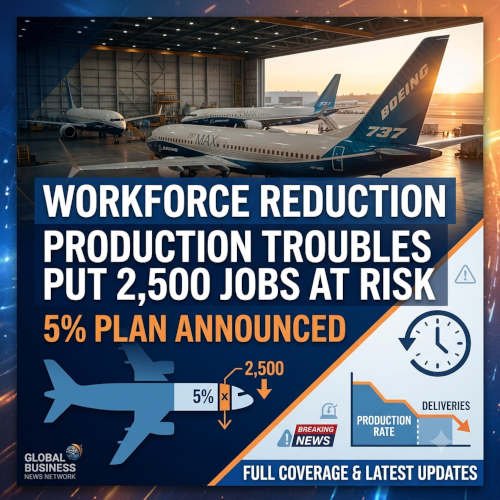
Boeing workforce reduction 2026: Boeing plans to reduce the workforce of its commercial airplane division by approximately 5% as the aircraft manufacturer slows its production expansion plans. The move comes as the company faces manufacturing challenges, supplier delays and difficulties meeting its aircraft delivery targets.
The planned reduction could affect approximately 2,500 positions, based on the division’s reported workforce of around 50,500 employees at the end of 2025. However, Boeing has not confirmed the final number of job losses or identified the locations and positions that will be affected.
According to reports published on November 9, 2026, Boeing Commercial Airplanes CEO Stephanie Pope informed employees that the company needs to adjust its production plans to give factories and suppliers more time to stabilize operations. The reductions will involve both involuntary layoffs and natural employee attrition, with notifications expected to begin in December.
The announcement raises fresh concerns for Boeing workers, suppliers and the wider aerospace industry. It also highlights the challenges facing the company as it attempts to rebuild production capacity and restore confidence in its manufacturing operations.
Why Is Boeing Planning a 5% Workforce Reduction?
Boeing says the planned workforce reduction is connected to changes in its commercial aircraft production schedules.
The company had been working to increase aircraft manufacturing as it tried to meet strong customer demand. However, production has not advanced as quickly as expected. Manufacturing bottlenecks and supply-chain difficulties have made it harder for Boeing to increase output at the planned pace.
In a message to employees, Stephanie Pope explained that the company needed to reset its production-rate increases. Boeing wants to give its factories and supply-chain partners additional time to achieve greater stability.
Pope also indicated that changes to production schedules and lower aircraft output had left the commercial airplane division with more employees than required under its revised business plan.
This means the announced cuts are linked to Boeing’s current production capacity rather than simply reflecting a lack of demand for new aircraft.
Reuters reported that Boeing plans to combine layoffs with attrition as it adjusts staffing levels. The company has not yet provided a complete breakdown of the positions or facilities involved.
How Many Boeing Employees Could Lose Their Jobs?
The planned 5% reduction could affect roughly 2,500 positions in Boeing Commercial Airplanes.
The estimate comes from the division’s reported workforce of approximately 50,500 employees at the end of 2025. Five percent of that figure represents around 2,525 positions.
However, this calculation does not confirm that Boeing will dismiss exactly 2,500 workers. The final number of layoffs could differ because the company intends to use a combination of involuntary job cuts and attrition.
Attrition generally refers to a reduction in staffing when employees leave through retirement, resignation or other departures and the company does not replace them. Involuntary layoffs involve employees losing their jobs through a company decision.
Boeing has not announced how many positions will be eliminated through each method.
The distinction matters because the headline figure describes the planned workforce reduction, not necessarily the number of employees who will receive termination notices.
Boeing’s commercial airplane division employed about 50,500 people at the end of 2025, while the company had nearly 182,000 employees across its wider operations. The announced 5% reduction applies to the commercial airplane division, not the entire company.
When Will Boeing Layoffs Begin?
Boeing employees affected by the workforce reduction are expected to receive notifications beginning in December 2026, according to reports from the Seattle Times and other news organizations.
The company has not released a detailed schedule explaining when individual employees will be informed or when their employment may end.
The notification process is expected to provide affected workers with information about their positions and available support. Boeing has previously described employee assistance and career-transition services as part of its workforce reduction measures.
The International Association of Machinists and Aerospace Workers District 751, which represents many Boeing machinists in the Puget Sound region, confirmed that the union had been notified before the announcement was shared with employees.
Union spokesperson Deirdre Kaniewski told Axios that the organization did not yet know how many workers would be affected or which employees and locations could face cuts.
The uncertainty is particularly important for workers in Washington state, where Boeing has a major manufacturing presence and supports thousands of jobs through its factories and supplier network.
Boeing Production Problems: Why the 737 MAX Is Important
Boeing’s production challenges are closely connected to its efforts to increase output of the 737 MAX family.
The 737 MAX is one of the company’s most important commercial aircraft programs. Increasing production is essential for Boeing because aircraft deliveries generate revenue and help the manufacturer improve its financial position.
However, the company has struggled to increase production at the speed it previously expected.
Reports on Boeing’s latest production plans indicate that the company has pushed back its target for increasing monthly 737 MAX production. Boeing had been working toward higher output, but manufacturing difficulties have forced executives to take a more cautious approach.
One challenge involves the production of aircraft wings at the company’s Renton, Washington, facility. Boeing executives have also discussed the need for greater reliability in the supply chain and aircraft manufacturing process.
According to reporting by the Seattle Times, Boeing told analysts during its third-quarter earnings call that it would miss its 2026 target of delivering 500 737 MAX aircraft.
The company has also adjusted its plans for other aircraft programs, including the 787 Dreamliner. These production challenges make it harder to increase deliveries and meet the company’s earlier growth expectations.
The decision to slow production increases reflects Boeing’s effort to avoid expanding output before its factories and suppliers are ready.
What Boeing Management Says About the Changes
Stephanie Pope, CEO of Boeing Commercial Airplanes, told employees that the company needs to adjust production plans to give factories and supply-chain partners more time to stabilize.
Her message acknowledged that Boeing has made progress over the past two years through investments in employees, training and manufacturing infrastructure. However, the company has not fully recovered from its earlier operational difficulties.
Pope’s message also indicated that Boeing must align its staffing levels with its revised business plan.
The company has been working to improve manufacturing quality, strengthen production processes and increase aircraft deliveries. But those improvements have not yet removed all the obstacles affecting its production targets.
The planned workforce reduction represents another step in Boeing’s attempt to match its employee numbers with its current manufacturing requirements.
The company has not publicly identified all affected locations, job categories or aircraft programs.
Why the Boeing Job Cuts Matter for the Puget Sound Region
Boeing is one of the largest private-sector employers in the Puget Sound region of Washington state. Its manufacturing facilities and supplier network support jobs in aircraft assembly, engineering, maintenance, logistics and other industries.
A 5% reduction in the commercial airplane division could therefore have consequences beyond the employees who directly lose their positions.
Local suppliers may also face uncertainty if Boeing changes production schedules or reduces demand for certain manufacturing services.
Small businesses that depend on Boeing employees and contractors could experience indirect effects. These may include reduced spending at restaurants, shops, housing services and other local businesses.
However, the full economic impact will depend on the final number of layoffs, the locations involved and whether affected workers find employment elsewhere in the aerospace industry.
The company has not confirmed which facilities will experience the largest changes.
For communities around Seattle, Everett and Renton, the December notification process will be important because it should provide a clearer picture of the potential impact.
Boeing’s Workforce Cuts Follow Earlier Job Reductions
The latest announcement comes after Boeing carried out a much larger workforce reduction in 2024.
At that time, the company announced plans to cut approximately 17,000 jobs, representing around 10% of its workforce. The reductions followed serious operational and financial pressures, including a machinists’ strike and the fallout from the January 2024 Alaska Airlines 737 MAX 9 door-plug incident.
Those events increased scrutiny of Boeing’s manufacturing practices and quality-control systems.
The company subsequently focused on improving production discipline, employee training and manufacturing quality. It also worked to strengthen relationships with regulators, airlines and suppliers.
The planned 2026 workforce reduction is different in scale and scope. It targets approximately 5% of the commercial airplane division as Boeing adjusts its production expansion plans.
Nevertheless, the announcement shows that the company’s recovery remains challenging.
What Happens Next for Boeing Employees and Aircraft Production?
Boeing’s next major step will be notifying employees who may be affected by the workforce reduction.
Those notifications are expected to begin in December 2026. Until then, employees and unions are waiting for more information about the number of positions involved and the facilities that could experience cuts.
Investors and airline customers will also be watching Boeing’s production performance closely.
The company needs to improve manufacturing consistency, strengthen supplier reliability and increase aircraft deliveries without creating additional quality problems.
Its ability to meet revised production targets will be important for its financial recovery and long-term competitiveness in the global aircraft market.
Airlines continue to depend on Boeing for new aircraft deliveries, while the manufacturer faces competition and pressure to demonstrate that it can produce aircraft reliably and on schedule.
The planned workforce reduction does not mean that demand for Boeing aircraft has disappeared. Instead, it reflects the gap between the company’s production ambitions and its current ability to manufacture aircraft at the desired rate.
More details about the affected jobs, locations and production plans are expected as Boeing moves toward the December notification period.
Frequently Asked Questions About Boeing Workforce Reduction 2026
Is Boeing cutting 5% of its workforce in 2026?
Boeing plans to reduce the workforce of its commercial airplane division by approximately 5%. The announcement does not mean the company is cutting 5% of its entire global workforce.
How many Boeing jobs could be affected?
Based on the division’s reported workforce of approximately 50,500 employees at the end of 2025, a 5% reduction could represent around 2,500 positions. The final number of layoffs has not been confirmed.
When will Boeing notify affected employees?
Reports indicate that Boeing employees affected by the planned reduction are expected to receive notifications beginning in December 2026.
Why is Boeing reducing its commercial airplane workforce?
Boeing is slowing production increases because its factories and suppliers need more time to stabilize operations. Revised production schedules have left the commercial airplane division with more employees than required under its updated business plan.
Will Boeing lay off all 2,500 employees?
No. The planned reduction will involve both involuntary layoffs and attrition. The company has not confirmed how many employees will be directly laid off.
Which Boeing locations will be affected?
Boeing has not announced a complete list of affected locations, divisions or job categories. The company and relevant unions are expected to provide more information as the notification process moves forward.
Is Boeing facing lower demand for its aircraft?
The workforce announcement is primarily connected to production challenges and revised manufacturing schedules. It does not establish that demand for Boeing aircraft has disappeared.
Final Takeaway
Boeing’s planned 5% commercial airplane workforce reduction highlights the continuing challenges facing the aircraft manufacturer as it attempts to stabilize production and improve operational performance.
The move could affect approximately 2,500 positions, although the final number of layoffs remains unconfirmed. With employee notifications expected to begin in December 2026, Boeing workers, unions, suppliers and investors will be watching closely for further details.
The company’s ability to resolve manufacturing bottlenecks and deliver aircraft more consistently will play a major role in determining how quickly its recovery progresses.