
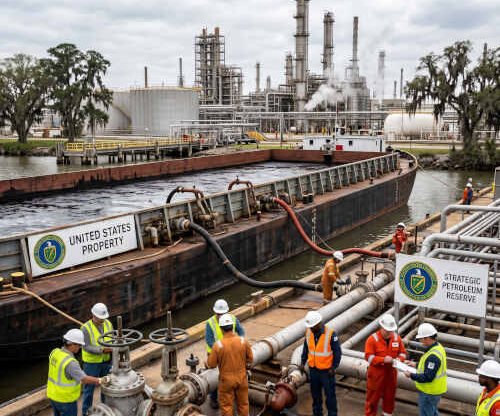

Texas, USA: Read on this portal all about the Uncle Sam oil business that is majority-controlled by the United States government so far. This is an ongoing issue and the talk of the town that every person talks about, either in shops or in meeting places. Is it true that the USA government has become one of the biggest foreign business investors and international bosses (Source: internet says)
As you have heard, the U.S. Department of Energy (DOE) has approved an emergency exchange of up to 400,000 barrels of crude oil from the Strategic Petroleum Reserve (SPR) to the Phillips 66 Lake Charles refinery in Westlake, Louisiana, following temporary, unspecified delivery disruptions.
This fast loan from the West Hackberry SPR site aims to prevent production halts at the 264,000-barrel-per-day (b/d) facility, which supplies a large portion of the Southeast and East Coast with transportation fuels like gasoline and diesel.
This is a turning point in the petroleum markets because of the same crude oil business. Apart from this other agreement and oil deal this year with the USA, including that of Venezuela North American Blue Energy NABEOP), a partner that manages 17 oil unit stations
Emergency Intervention in the petroleum sector, but why
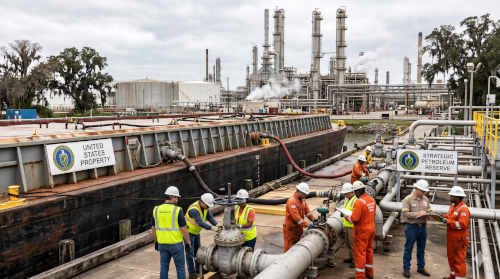
On Friday, Oct. 23, 2026, the DOE authorized the emergency loan to Phillips 66. The department noted that the crude is intended to “help offset temporary disruptions affecting crude oil deliveries to the refinery and support continued production of transportation fuels serving Louisiana and surrounding markets.”
Neither the DOE nor Phillips 66 has disclosed the exact nature of the delivery problem, and OPIS reporting via MarketWatch confirmed that the cause remains unspecified.
As you see, more of its control is done and regulated by the government as a powerful trader, and it may resutlts also have effects on the global energy scenario and others.
Even though this deal has succeeded, many politicians and legal executives expressed their ideas and opinions against the deal. The major concern that arises, according to experts, is the inclusion of the traditional oil companies such as ExxonMobil, and another major concern is the Taxpayer money risk,
Strategic Reserves At Lowest Level Since 1982
A clever approach Uncle Sam is doing, While the 400,000-barrel loan represents about a day and a half of the refinery’s total daily capacity, it draws from a severely diminished reserve.
On the basis of U.S. Energy Information Administration (EIA) weekly data, the SPR held 282.683 million barrels for the week ending Oct. 16, 2026—the lowest weekly level recorded since October 1982, when the reserve was still being initially filled. For context, the SPR peaked at roughly 726.6 million barrels in January 2010.
| Category | Crude Reserve Volume (Barrels) | Historical Context / Era |
| Current SPR Level (Oct. 16, 2026) | 282.683 Million | Lowest level since October 1982 |
| Historical SPR Peak (Jan. 2010) | 726.6 Million | Peak capacity |
| Active Loan to Phillips 66 | Up to 400,000 | Emergency bridge for Lake Charles |
This retardation is the result of multiple multi-million-barrel drawdowns over the years, including major releases to combat supply shocks following Russia’s invasion of Ukraine and later disruptions stemming from conflict involving Iran.
Exchange Terms and Return Premiums
Because this intervention is structured as an exchange and not a direct sale, Phillips 66 is legally required to return the borrowed volume to the SPR with “additional premium barrels” at a future, undisclosed date.
Under Secretary of Energy Kyle Haustveit emphasized that this premium-based system ensures the reserve will eventually see a net gain in crude at no additional cost to taxpayers, though the DOE has not yet published the exact size of the premium or the return timeline.
Phillips 66 is scheduled to host its third-quarter 2026 earnings webcast on Wednesday, Oct. 28, where investors and industry analysts will be watching closely for updates on the Lake Charles supply situation and the terms of the SPR return.
Analysis: A Necessary Bridge with a Thin Cushion
From an operational standpoint, this sudden exchange represents the SPR functioning exactly as intended: as a rapid, short-term bridge to prevent localized fuel shortages.
However, with the SPR sitting at half its historical peak, the margin for error has worn thin. While the “premium barrel” system guarantees a net gain over time, the speed at which the U.S. can regain its strategic reserves remains a pressing concern for long-term energy security.
Frequently Asked Questions
What is the Strategic Petroleum Reserve (SPR)?
The SPR is a U.S. government-owned stockpile of crude oil, stored in underground salt caverns in Louisiana and Texas, designed to mitigate the impact of severe energy supply disruptions.
How many barrels is the DOE lending to Phillips 66?
The DOE approved an emergency exchange of up to 400,000 barrels of crude oil from the West Hackberry SPR site.
Sources:
- Energy.gov Strategic Petroleum Reserve Announcements
- EIA Weekly Stocks of Crude Oil in the SPR
- Phillips 66 Refining & Operations
- Hydrocarbon Processing: U.S. Authorizes Emergency Release of Up to 400,000 Oil Barrels
- OilPrice: U.S. Dips Into Strategic Oil Reserve Again Amid Supply Disruptions
- Seeking Alpha: DoE Authorizes 400K-Barrel Emergency SPR Release for Phillips 66